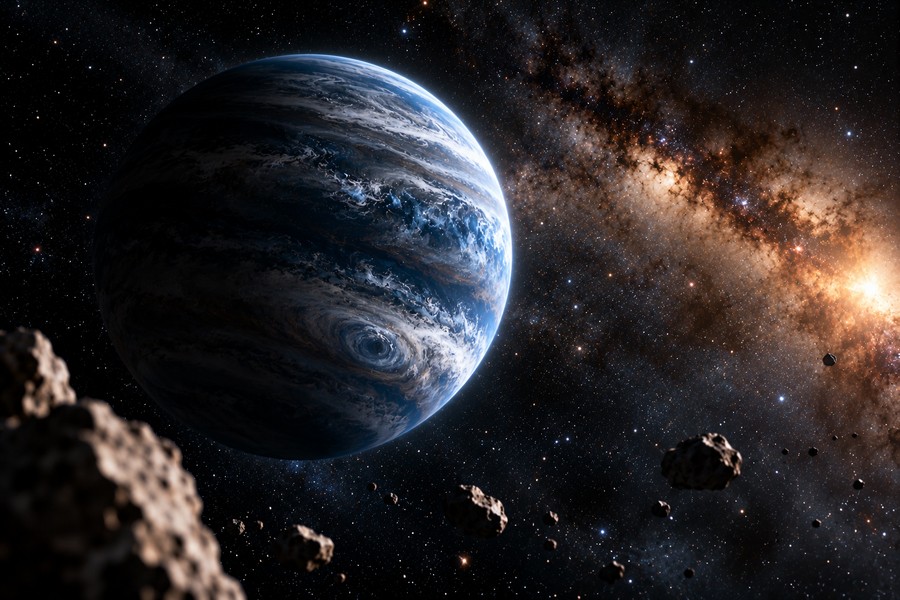
Imagine standing on the surface of a planet where the Sun never rises. There is no familiar sunrise, no golden horizon and perhaps no bright star close enough to illuminate the landscape. Above you, the sky remains dark, interrupted only by distant stars. This is the unsettling possibility presented by rogue planets. Unlike Earth, Jupiter or the thousands of exoplanets discovered around distant stars, rogue planets travel through space without being gravitationally bound to a host star. Some may have formed within ordinary planetary systems before being thrown into interstellar space. Others may have developed independently from collapsing clouds of gas, more like extremely small stars. For astronomers, these wandering worlds represent a major challenge. They are difficult to detect, often extremely faint and capable of revealing a side of planetary formation that conventional exoplanet searches can easily miss. The most intriguing question is not simply how they survive without a star. It is how many may be travelling through the Milky Way completely unnoticed.
What Exactly Is a Rogue Planet?
A rogue planet, sometimes called a free-floating or interstellar planet, is a planetary-mass object that does not orbit a star. That definition sounds straightforward, but classification can become complicated. Some objects have masses comparable to Jupiter yet may have formed through the gravitational collapse of a gas cloud rather than inside a planet-forming disc. These objects occupy an uncertain boundary between planets and brown dwarfs, which are bodies more massive than typical planets but generally unable to sustain ordinary hydrogen fusion like stars. For that reason, astronomers often use the more cautious term free-floating planetary-mass object. The distinction matters because appearance alone cannot tell us how an object formed. Understanding what an exoplanet is helps explain why astronomers distinguish planets orbiting distant stars from free-floating planetary-mass objects. A world travelling through interstellar space could be an expelled planet, an independently formed object or something whose history remains impossible to reconstruct with current observations.
How Does a Planet Lose Its Star?
Planetary systems are not always peaceful places. During their early development, several large planets may compete for stable orbits around the same star. Their gravitational interactions can dramatically change the shape and size of their paths. If one planet passes sufficiently close to another massive planet, it may receive a gravitational boost that sends it into a much wider orbit. In extreme cases, the encounter gives it enough energy to escape the star's gravitational influence entirely. The result is a rogue planet. This process is known as gravitational scattering. It can occur during the chaotic early history of a planetary system, although disturbances later in its lifetime may also eject planets. Passing stars and changes within multiple-star systems can contribute to orbital instability. A planet does not need to collide with anything to be expelled. Gravity alone can send it into interstellar space. Planetary resonance offers a useful contrast, showing how gravitational interactions can sometimes maintain stable orbital relationships rather than disrupt them.
Can Rogue Planets Form Without Stars?
Possibly, and this is one reason their origins remain difficult to study. Stars form when sufficiently dense regions of gas and dust collapse under gravity. In some circumstances, relatively small collapsing fragments may produce objects with planetary masses. These bodies would not necessarily have formed within a conventional planetary system. Instead, they could emerge as isolated objects from the beginning. Astronomers have identified young planetary-mass candidates in star-forming regions, where their residual heat makes them easier to observe. However, determining whether an individual object formed through direct collapse or planetary ejection is often difficult. Mass, age, chemical composition and motion can provide clues, but no single observation always settles the question. Rogue planets may therefore represent more than one population with different origins.
How Many Rogue Planets Exist in the Milky Way?
Nobody knows the exact number. Some research suggests that free-floating planets could be extremely common, potentially numbering in the billions or even trillions across our galaxy. However, estimates depend heavily on the masses being considered and the assumptions used to interpret observations. A 2023 study using gravitational microlensing data suggested that low-mass free-floating or widely separated planets could be particularly abundant. The researchers estimated that the population of such objects might greatly exceed the number of stars. That result attracted attention because it suggested that planetary systems could lose large numbers of smaller worlds during their evolution. But these estimates remain uncertain. A short microlensing event can be produced by an isolated planet or, in some cases, a planet orbiting so far from its star that the star's gravitational influence is not detected. Future observations will be needed to distinguish these possibilities more reliably.
How Can Scientists Detect a Planet Without a Star?
Finding an ordinary exoplanet often involves observing how it affects its parent star. Astronomers may detect a small dip in starlight when a planet passes in front of its star or measure the star's movement under the planet's gravitational influence. Neither approach works in the same way for an isolated planet. Instead, researchers use several other methods. Young rogue planets can retain heat from their formation, making them visible in infrared observations. As they age and cool, they generally become much harder to detect. Another important technique is gravitational microlensing. When a massive object passes between Earth and a more distant star, its gravity bends and magnifies the background starlight. The temporary brightening can reveal an otherwise invisible object. For a planetary-mass body, the event may last only hours or days. Scientists can use its duration and other characteristics to estimate properties of the lensing object, although determining its precise mass and distance may require additional observations. For a broader explanation of the techniques used to discover distant worlds, see our guide to exoplanet detection methods.
What Happens to a Planet After It Is Ejected?
A planet escaping its star does not suddenly stop moving. It continues travelling through the galaxy under the combined gravitational influence of the Milky Way and nearby objects. Its surface environment, however, may change dramatically. Without a nearby star, an exposed rocky planet would lose its principal source of external heat and light. Surface temperatures could fall sharply, and any existing atmosphere might undergo major changes. Water at the surface would generally freeze under sufficiently cold conditions. A gas giant would behave differently. Its thick atmosphere and internal heat could remain important for a long time, particularly if the object is young or massive. The fate of a rogue planet therefore depends on its composition, mass, age and the conditions it experienced before becoming isolated.
Could a Rogue Planet Have an Atmosphere?
Yes. A planet does not need to orbit a star to possess an atmosphere. Whether that atmosphere survives depends on several factors, including gravity, temperature, atmospheric composition and the planet's history. A massive rogue planet could retain substantial quantities of gas. A smaller rocky world might retain an atmosphere under certain conditions, although some gases could freeze onto its surface as temperatures fall. Without sunlight, the atmosphere would also behave differently from Earth's. There would be no ordinary solar-driven weather system, and the energy available to power atmospheric circulation could be much more limited. Nevertheless, internal heat and chemical processes could still influence atmospheric conditions. The absence of a star does not automatically mean the absence of every familiar planetary feature.
Could Rogue Planets Have Liquid Water?
Liquid water might exist on a rogue planet even without sunlight, although no such ocean has been confirmed.
Internal heat from radioactive decay and the planet's formation could help maintain water beneath an insulating layer of ice. Some theoretical models also suggest that a sufficiently thick hydrogen-rich atmosphere might trap enough heat to support liquid water under particular conditions.
These possibilities depend on the planet's mass, composition and long-term thermal evolution. They do not mean that most rogue planets are habitable.
The conventional habitable zone focuses on the energy a planet receives from its star. Rogue planets show why scientists also investigate environments heated from within.
Could Life Exist on a Rogue Planet?
No life has been detected on a rogue planet. Nevertheless, scientists can investigate whether such worlds might sustain environments suitable for microbial life.
If an isolated planet retained a subsurface ocean, internal heating and chemical reactions between water and rock could potentially supply energy without sunlight. Similar processes are relevant to the study of icy moons in our Solar System.
However, liquid water alone would not establish habitability. A stable environment, suitable chemistry and a continuing energy source would also be necessary.
Our article on life beneath the ice on other worlds examines why subsurface oceans are scientifically interesting, while distinguishing potential habitability from evidence of living organisms.
Could a Rogue Planet Have Moons?
A wandering planet could potentially retain moons after escaping its original planetary system. Whether those moons survive would depend on the circumstances of the ejection. A violent gravitational encounter might strip away some satellites, while others could remain gravitationally bound to the planet. If a surviving moon followed an eccentric orbit, tidal interactions might generate internal heat. That raises the theoretical possibility of geologically active moons orbiting planets that themselves orbit no star. However, confirmed examples of such systems remain elusive. The idea is physically plausible, but its frequency is unknown. Future discoveries may reveal whether isolated planets commonly travel through space with smaller companions.
Could a Rogue Planet Enter Our Solar System?
A rogue planet could theoretically pass through the Solar System, depending on its trajectory and gravitational interactions with the Sun and planets.
However, planetary-sized objects are widely separated in space, and a close encounter would be uncommon. The existence of rogue planets does not imply that one is approaching Earth.
There is no verified evidence of a rogue planet currently heading towards our planet on a collision course. Any credible warning would require astronomical observations and a calculated trajectory, not an unsupported prediction.
What Will Future Telescopes Reveal?
The next major advances may come from surveys designed to detect gravitational microlensing events. NASA's Nancy Grace Roman Space Telescope is expected to investigate large numbers of distant objects using its wide-field observations. Its microlensing survey should help scientists measure the abundance of free-floating planetary-mass objects, particularly those difficult to detect through direct imaging. Researchers will also continue using infrared telescopes to study young, isolated planetary-mass candidates. Combining these methods may help distinguish planets expelled from stellar systems from objects formed independently. More importantly, a larger sample could reveal whether rogue planets are rare accidents or a common outcome of planetary formation.
Why Rogue Planets Matter
Rogue planets challenge one of our most familiar assumptions about the universe: that planets naturally belong to stars. Many probably do. But planetary systems evolve, gravitational encounters can be violent and some worlds may never have formed around a star in the first place. These objects provide clues about planetary migration, gravitational instability and the history of star-forming regions. They also expand the discussion of habitability beyond planets receiving sunlight from a nearby star. The most compelling aspect of rogue planets is not the possibility of a hidden civilisation travelling through darkness. It is the real prospect that our galaxy contains an enormous population of worlds we have barely begun to detect. Some may be frozen and inactive. Others could retain thick atmospheres, internal heat or surviving moons. Until better observations become available, their true diversity remains an open question. The Milky Way may contain far more planets than the familiar picture of stars surrounded by orderly planetary systems suggests.
Sources and Further Reading
NASA — New Study Reveals Roman Could Find 400 Earth-Mass Rogue Planets
NASA Science — Roman Space Telescope: Exoplanets
NASA Science — How Do You Find and Confirm a Planet?
NASA Science — Exoplanet Facts
The Astronomical Journal — Microlensing Research on Free-Floating Planets (Preprint)